


Businesses that invest in SEO often hit a wall after a few months. Rankings do not move, traffic stays flat, and nobody can explain why. Most of the time, the answer is simple: they worked on one side of SEO and left the other side untouched.
Two Sides of the Same System
SEO has two main areas: what you do on your own website, and what happens outside of it. Both send signals to Google. Both affect where your pages rank. Ignoring one while working on the other is like training one leg and wondering why you cannot run straight.
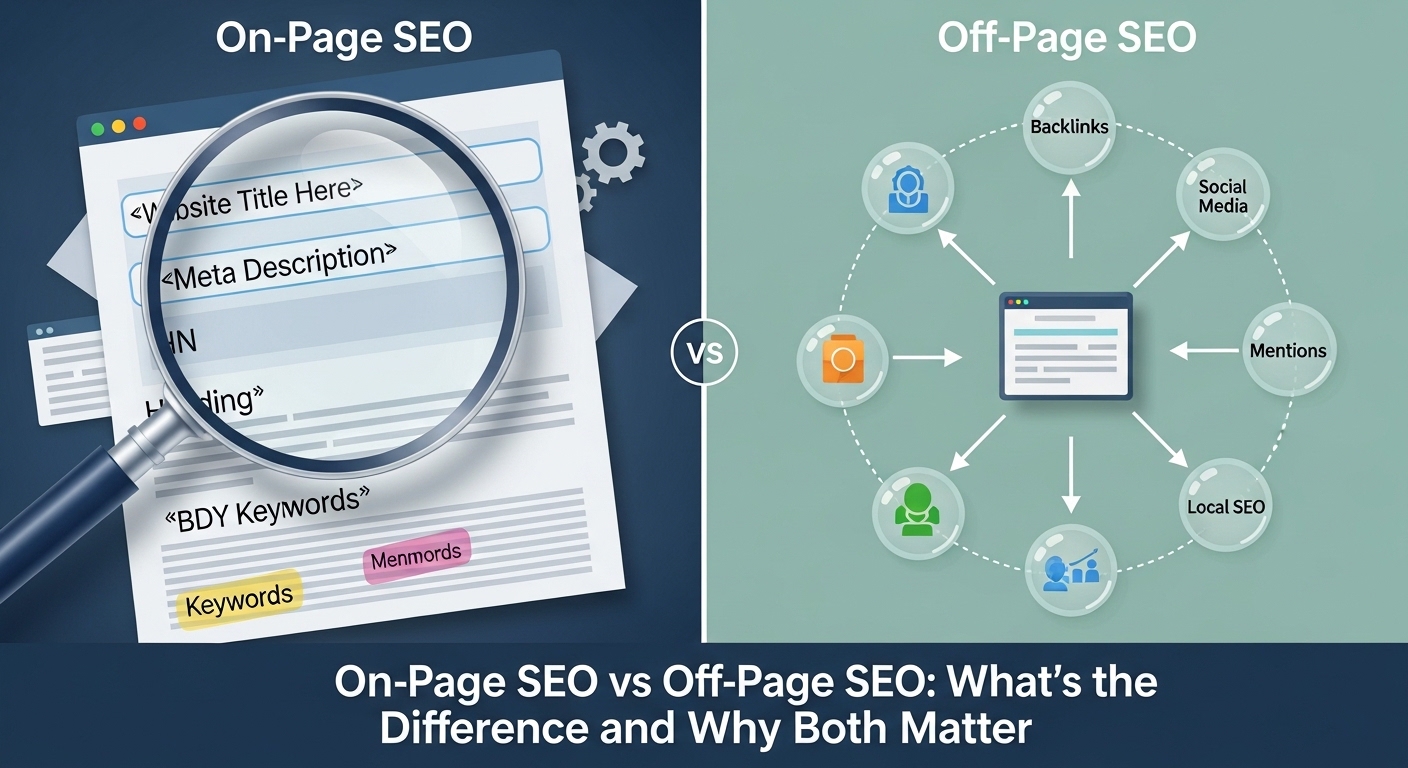
On-page SEO is everything you control directly on your website. Off-page SEO is everything that builds your authority from the outside. Google weighs both when it decides which pages to rank and in what order.
What On-Page SEO Actually Covers
On-page SEO is the foundation. Before Google can rank your page, it needs to understand what the page is about, who it is for, and whether it answers the search query well.
The Core Elements of On-Page SEO
- Title tags and meta descriptions: These tell search engines and users what the page covers before they click
- Header structure (H1, H2, H3): Organizes the content so Google can read it clearly
- Keyword placement: The target keyword should appear in the title, first paragraph, and naturally throughout the body
- Internal linking: Connects your pages together so Google understands the structure of your site
- Content depth: Thin pages with little information rank poorly. Pages that cover a topic fully perform better
- Page speed and Core Web Vitals: Google uses load time and user experience as ranking factors
- Image optimization: Alt text, file names, and image size all affect how search engines read your visuals
According to Google’s own documentation on how Search works, the search engine analyzes content, structure, and relevance together when deciding rankings. On-page SEO directly shapes all three.
For commercial businesses, this means every service page needs proper structure, a clear keyword focus, and enough content to answer what a potential client is actually searching for.
What Off-Page SEO Covers
Off-page SEO is about authority and trust. Google does not just want to know what your page says. It wants to know whether other websites and sources consider your website worth referencing.
How Off-Page SEO Builds Authority
The main component of off-page SEO is backlinks. When another website links to yours, it passes a portion of its authority to your page. The more high-quality backlinks a page has, the stronger its position in search results.
But off-page SEO covers more than just links:
- Backlink quality: A link from a high-authority industry website carries far more weight than ten links from low-quality directories
- Brand mentions: Even unlinked mentions of your business name across the web contribute to your authority signals
- Google Business Profile signals: Reviews, citations, and local authority for businesses targeting location-based searches
- Social signals and press coverage: These bring indirect traffic and increase the chances of earning more backlinks
One study by Backlinko analyzing over one billion pages found that the number of referring domains pointing to a page is one of the strongest ranking factors in Google’s algorithm. Businesses that ignore off-page SEO find that even well-optimized pages struggle to rank against competitors with stronger link profiles.
Also Read:
Why You Cannot Succeed With Just One
This is the part most businesses miss. Working only on on-page SEO gives you a well-structured website that Google understands but does not trust enough to rank highly for competitive keywords. Working only on off-page SEO gives you backlinks pointing to pages that do not clearly communicate what they are about or why they matter.
You need both working together.
A simple way to see it:
- On-page SEO tells Google what you are and what you offer
- Off-page SEO tells Google that other sources agree you are worth showing
For commercial businesses in competitive markets, this combination is what separates page one results from page three results. Your competitor ranking above you is almost always running both sides of SEO at the same time.
Common Gaps Businesses Have Right Now
Most businesses we look at have one of these problems:
- Service pages with no clear keyword structure or thin content
- No internal linking between related pages
- Zero backlinks from relevant industry or local sources
- Google Business Profile with no consistent citations across directories
- Fast website, but pages that do not fully answer what the searcher needs
Any one of these gaps limits how far your SEO can go.
Build Both Sides With Rank Metrics
Rank Metrics works with commercial businesses that want to stop guessing why their rankings are stuck. Whether your site needs a full on-page SEO audit or a backlink strategy to build authority in your market, the starting point is understanding exactly where the gaps are.
Rankings do not improve by accident. Contact our team and get a clear picture of what your site needs on both sides of SEO to start moving.